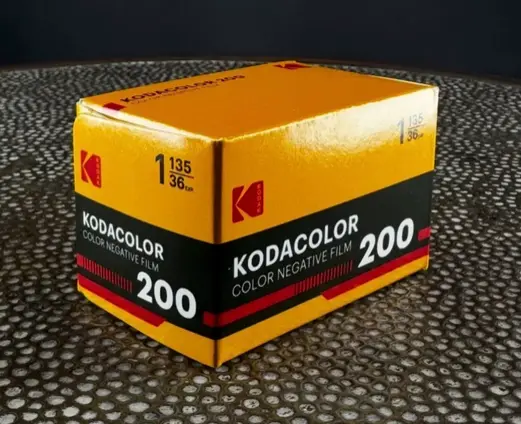
Test of the New Kodak Kodacolor 200 Film: The Return of an Accessible Classic
Announced in 2025, the Kodak Kodacolor 200 marks the return of a legendary name in analog photography. Behind this launch lies a clear strategy: to offer an affordable, widely available color film that supports the ongoing revival of film photography.
In this article, we test and analyze this new film—its characteristics, rendering, use cases, and positioning within the Kodak film lineup.
A Strategic Launch Supporting the Film Revival
In October 2025, Eastman Kodak announced the release of Kodacolor 100 and 200 films, marking its return to direct film distribution for the first time since 2012.
This launch comes amid strong demand and rising prices for color film. The goal is to improve availability and stabilize pricing through increased production and a simplified distribution chain.
Technical Characteristics of Kodak Kodacolor 200
Kodacolor 200 is a daylight-balanced color negative film designed for versatile use.
Key specifications :
- 🎞️ Color negative film (C-41)
- 📸 Sensitivity: ISO 200
- 🌞 Daylight balanced
- 🔍 Fine grain and good sharpness
- 🎨 Saturated colors with faithful reproduction
- 📷 Wide exposure latitude
This combination makes it an all-purpose film suitable for most photographic situations.

Color Rendering and Aesthetic
Colors
Kodacolor 200 produces saturated yet natural colors, with warm skin tones and a balanced palette.
👉 The rendering is often described as slightly warm, reminiscent of family photo albums from the 1980s and 1990s.
Contrast
- Moderate contrast
- Good midtone separation
- Smooth highlight roll-off
This profile makes it easy to scan and edit.
Grain and Sharpness
The grain is fine for an ISO 200 film, offering a good level of detail and strong sharpness.

Exposure Latitude: A Forgiving Film
Kodacolor 200 offers wide exposure latitude, capable of handling several stops of overexposure or underexposure.
👉 This makes it an excellent choice for :
- Cameras without reliable light meters
- Beginners
- Spontaneous photography

Performance
Ideal Situations
- Travel photography
- Portraits in natural light
- Landscapes
- Everyday photography
Thanks to its ISO 200 speed, it performs best in well-lit scenes.
Limitations
- Less suitable for low light without flash
- Grain becomes more visible when underexposed
- Less refined than professional films (Portra, Ektar)

A New Film… or an Evolution of ColorPlus?
Many indications suggest that Kodacolor 200 is very close to ColorPlus 200, possibly a rebranding aimed at improving distribution and clarifying the product lineup.
This repositioning remains important:
✔ Improved availability
✔ More stable pricing
✔ Clear identity for new photographers


Who Is Kodak Kodacolor 200 For?
This film is particularly suited to:
- Beginners in analog photography
- Budget-conscious photographers
- Fans of warm vintage rendering
- Users seeking a versatile film
Verdict: Should You Try Kodacolor 200?
Kodacolor 200 may not be a technical revolution, but it perfectly meets current photographers’ expectations: an accessible, reliable, and aesthetically pleasing film.
Strengths
✔ Affordable price
✔ Warm, natural colors
✔ Versatile and forgiving
✔ Improved availability
Things to consider
✖ Limited innovation compared to ColorPlus
✖ Less performant than professional films


Conclusion
The return of the Kodacolor name with Kodacolor 200 symbolizes a new step in the revival of analog photography. Accessible, versatile, and enjoyable to use, it is an excellent entry point into the world of color film.
🎞️ More than a new release, Kodacolor 200 represents the promise of a more accessible analog experience — and that may be exactly what the community needs.
Buy Kodacolor 200 film in our online shop